Texas Marine Cold-Water
Response Collaborative (TCRC)
2026 Workshop
Texas Marine Cold-Water Response Collaborative Workshop
March 18th, 2026
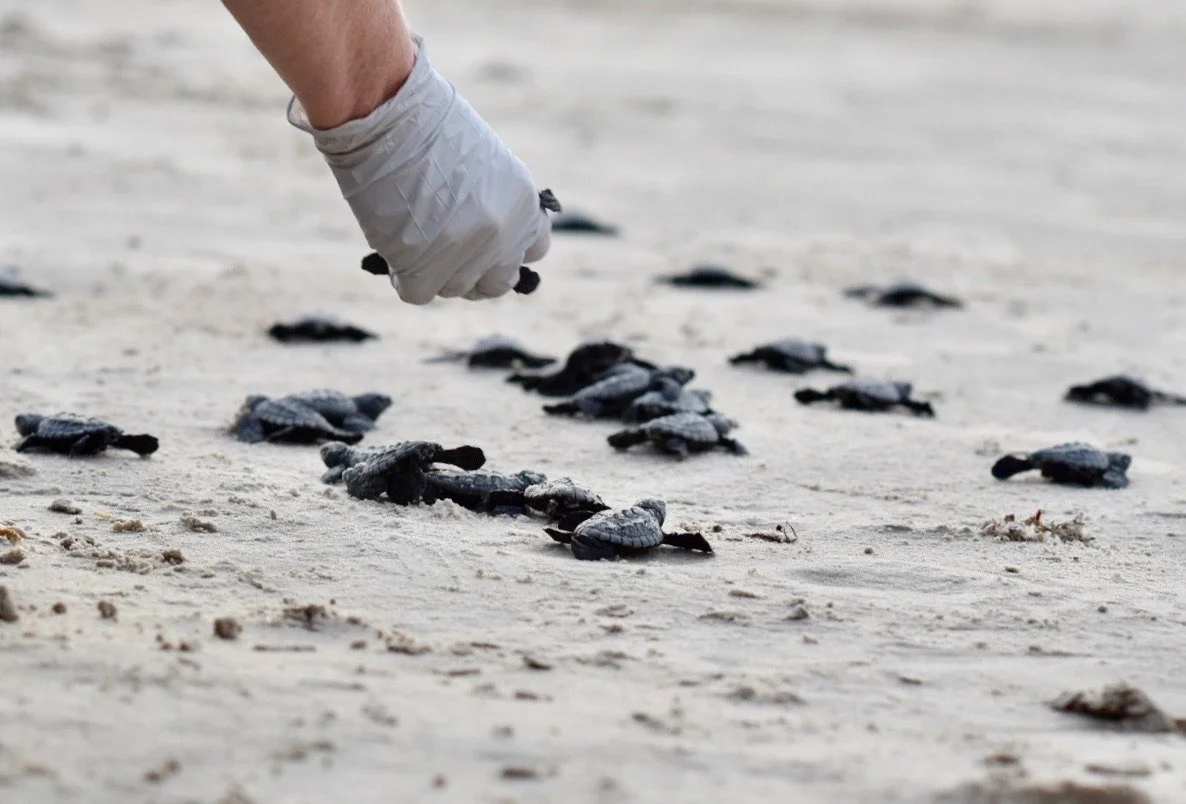
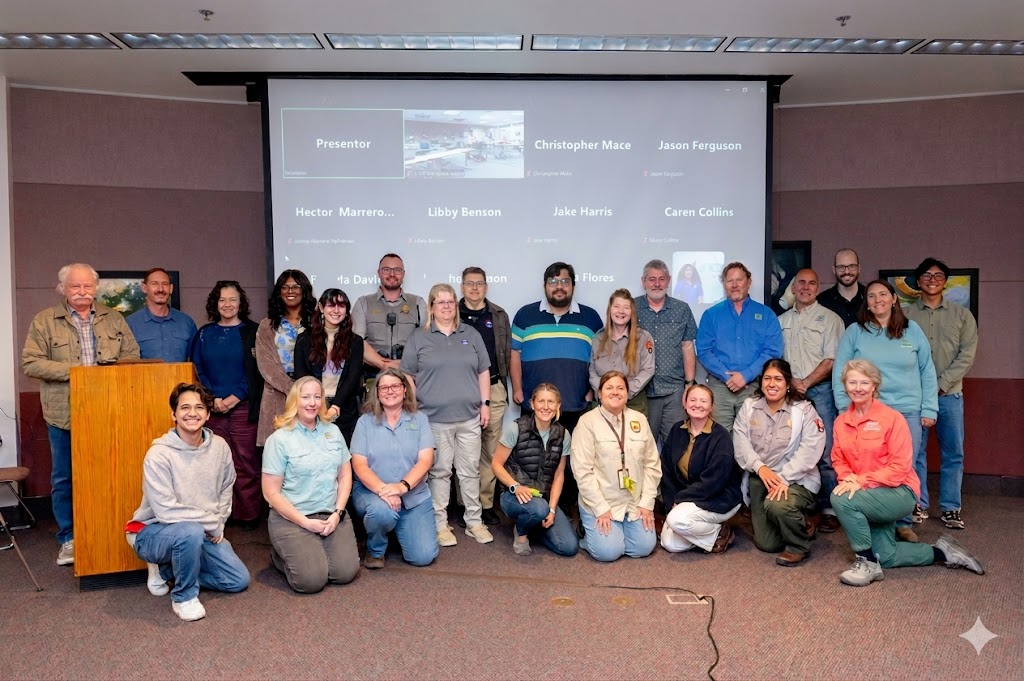
On March 18th, 2026, researchers at Texas A&M University–Corpus Christi (TAMU-CC) Conrad Blucher Institute (CBI) hosted a one-day workshop with 40 members of the Texas Marine Cold Water Response Collaborative (TCRC) and other stakeholders interested in cold stunning events. The focus: a newly operational AI model — now equipped with full uncertainty quantification — for predicting cold-stunning events that render sea turtles and fishes lethargic along the Texas coast. With all seven sea turtle species along the coast listed as threatened or endangered under the U.S. Endangered Species Act, accurate forecasts are central to preparation and rescue operations that can involve thousands of animals in a single event. The collaborative that became the TCRC, active since 2009, coordinates state agencies (including Texas Parks and Wildlife), private-sector partners (including the Gulf Intracoastal Canal Association), and NGOs (including
the Coastal Conservation Association), pooling jurisdictions and resources to mitigate cold-stunning impacts — including rescuing stranded turtles and, when necessary, requesting for voluntary interruption of navigation and dredging in the Laguna Madre. AI predictive models have supported these operations since the collaborative's founding. The development and implementation of the new model was made possible by the National Science Foundation AI2ES AI institute, the NOAA Center for Coastal and Marine Ecosystems (CCME), and the Texas Parks and Wildlife Department with contributions for the National Park Service. AI2ES co-PI Dr. Philippe Tissot opened the workshop and moderated discussion over the topics listed in the following sections:
Historical context. Dr. David McKee traced cold-stunning events on the Texas coast back to a 1527 freeze in Galveston Bay and an 1845 event that helped feed General Zachary Taylor's troops. Systematic tracking began with Henry H. Hildebrand's, also known as H3, work in 1957 including on the major freezes of 1983 and 1989, when fishes in the Laguna Madre landcut were found with gill cavities packed with black mud. McKey underscored that events on this scale, and larger than 2021's Winter Storm Uri, will occur again.
Decisions and Leadership ahead of Cold-Stunning Events. Alex Nunez, from the Texas Parks and Wildlife Department (TPWD) and one of the leaders of the project from its early conception, shared the importance of the program to the state agency and how predictions are integrated in the workflow and decision making process ahead of the cold-stunning events. Alex Nuñez and his colleagues, several in attendance, also shared new research conducted during the 2026 cold- stunning event, aiming to better monitor the impact and the dynamic of the cold-stunning conditions in the Land Cut. The President of the Gulf Intracoastal Canal Association (GICA), Paul Dittman, shared the important contributions of the association and its members to the overall program. Dittman also explained how navigational interruptions unfold along the Laguna Madre, as well as their impacts on the overall supply chain. GICA is one of the founding members of the TCRC and their effort to halt port operations since the group’s start in the mid 2000’s.
Rescue operations. Dr. Donna Shaver drew on her career-long dedication to the study of sea turtles and her tenure coordinating the Sea Turtle Stranding and Salvage Network. Dr. Shaver described how outcomes have improved: whereas early responses recovered few live turtles, coordinated rescue, rehabilitation, and release into warmer Gulf waters now save the majority of stranded animals. Predicting event magnitude remains a key open challenge.
Stakeholder trust and the case for uncertainty quantification. Dr. Miranda White (TAMU-CC) presented two studies. The first, based on interviews with TCRC members, mapped how stakeholder group's context and priorities shape their contribution to the collaborative. Members reported strong trust in the predictions and a deep mutual understanding across groups — a foundation that has enabled to come to consensus on high-stakes decisions such as requesting for the voluntary suspension of Laguna Madre navigation and dredging. Interviewees also expressed a desire for uncertainty information alongside the existing water-temperature forecasts. Her second presentation introduced the model developed in response: a multi-year AI2ES collaboration with the University of Oklahoma, NCAR, The Weather Company, and other partners that combines epistemic and aleatoric uncertainty into a single operational forecast. Dr. White presented a proposed visualization for end users. The model is described in a forthcoming article in the AMS Artificial Intelligence for the Earth Systems (AIES) journal (in press).
Expansion northward: Ayesha Khan, undergraduate researcher at TAMU-CC and member of the "Cool Turtles" team, previewed a new model predicting water temperatures in Espiritu Santo Bay, extending cold-stunning forecasts to a northern Texas bay in time for the 2026–27 winter season.
Lower Laguna Madre: At the conclusion of the workshop, Dr. Tissot discussed the water temperature differences between Upper and Lower Laguna Madre. The Laguna Madre predictions are meant for the full Laguna Madre. Until recently we did not have good water temperature measurements for Lower Laguna Madre (TCOON & NWLON stations are too close to ship channel or tidal flats). Thanks to measurements from Sea Turtle Inc. (thank you!) we have measurements for the 2026 cold stunning event. The data shows a warmer Lower Laguna Madre before and after the cold stunning event but similar water temperatures during the event as compared to Upper Laguna Madre. For the foreseeable future the Laguna Madre model will continue to be meant to guide the full Laguna Madre while more data is needed to study the differences.
The workshop closed with discussion of extending the Laguna Madre model to the water body's southern reaches and setting research priorities for the coming years. If you would like to learn more about the TCRC’s latest workshop, their regular operations in the Texas Gulf Coast, and the research guiding their rescues, please visit check the CDL Projects page or contact Dr. Philippe Tissot (philippe.tissot@tamucc.edu).
If you reference, share, or reuse talks, presentations, or other material from this page, please cite it as:
Texas Marine Cold-Water Response Collaborative (TCRC). (2026). Texas Marine Cold-Water Response Collaborative Workshop: Talks and Presentations. Workshop held March 18, 2026, Texas A&M University-Corpus Christi, Corpus Christi, TX. Retrieved from https://www.coastaldynamicslab.org/water-temperature-predictionsTo cite an individual talk, use one of the following citations:
McKee, D. . (2026, March 18). A brief history of the roots of the TCRC – the 1983 Event. Texas Marine Cold-Water Response Collaborative Workshop, Texas A&M University-Corpus Christi, Corpus Christi, TX. https://www.coastaldynamicslab.org/water-temperature-predictionsTissot, P.E. . (2026, March 18). Reminder of the mission of the TCRC, membership and timing of actions ahead of a potential cold stunning. Texas Marine Cold-Water Response Collaborative Workshop, Texas A&M University-Corpus Christi, Corpus Christi, TX. https://www.coastaldynamicslab.org/water-temperature-predictionsNunez, A. . (2026, March 18). Cold stunning program from TPWD point of view and impact on fisheries and sea turtles. Texas Marine Cold-Water Response Collaborative Workshop, Texas A&M University-Corpus Christi, Corpus Christi, TX. https://www.coastaldynamicslab.org/tcrc
Dittman, P. . (2026, March 18). Cold stunning program and GICA's contributions and how they can be facilitated. Texas Marine Cold-Water Response Collaborative Workshop, Texas A&M University-Corpus Christi, Corpus Christi, TX. https://www.coastaldynamicslab.org/tcrcShaver, D. . (2026, March 18). Cold stunning impacts on sea turtles with historical numbers and perspective. Texas Marine Cold-Water Response Collaborative Workshop, Texas A&M University-Corpus Christi, Corpus Christi, TX. https://www.coastaldynamicslab.org/tcrcWhite, M. . (2026, March 18). What we learned from our stakeholders, TCRC interactions, surveys results. Texas Marine Cold-Water Response Collaborative Workshop, Texas A&M University-Corpus Christi, Corpus Christi, TX. https://www.coastaldynamicslab.org/tcrcWhite, M. . (2026, March 18). Introduction of the new cold stunning model with uncertainty quantification. Texas Marine Cold-Water Response Collaborative Workshop, Texas A&M University-Corpus Christi, Corpus Christi, TX. https://www.coastaldynamicslab.org/tcrcKhan, A. . (2026, March 18). Presentation of upcoming model and related measurements for Espiritu Santo Bay. Texas Marine Cold-Water Response Collaborative Workshop, Texas A&M University-Corpus Christi, Corpus Christi, TX. https://www.coastaldynamicslab.org/tcrcTissot, P.E. . (2026, March 18). 2025-2026 cold water season measurements and predictions for the Lower Laguna Madre. Texas Marine Cold-Water Response Collaborative Workshop, Texas A&M University-Corpus Christi, Corpus Christi, TX. https://www.coastaldynamicslab.org/tcrcThis work is licensed under a Creative Commons Attribution 4.0 International License (CC BY 4.0)